
SUSTAINABILITY
(IS OUR CORE)
Sustainable materials
Organic and Recycled Cotton
GOTS (Global Organic Textile Standard) is a textile processing standard for organic fibers, including ecological and social criteria.
We believe that organic is one of the best answers. The answer to our future, to protect Earth, to be sustainable, to be kind to our skin.
All our collections are as responsible and sustainable as they can be, so we are always looking for the best way to go, especially about our fabrics and materials.
You can find that 40% of pieces in our collections made with Organic Cotton, Lotus or Hemp.
Every time you see the GOTS logo at the end of a product page, you can be sure it was made with certified fabrics, that came from places like India, Portugal, Turkey and Germany.
We also use recycled cotton in yarn, for our macramé pieces and some knitted tops.
If you have any question about our organic products, please contact us.
Sustainable
materials
Lyocel
Lyocell is made from wood pulp, normally eucalyptus trees, which are fast growing and reach full maturity in approximately seven years. Lyocell is made of generated cellulose fiber, which is an organic compound. It is a renewable bio-based fiber.
Apart from growing very quickly, Eucalyptus requires no artificial irrigation or gene manipulation. Trees are grown in fully licensed sustainably managed forests and some producers are currently exploring options to become organically certified.
Lyocell is fully biodegradable and will degrade within 6 weeks on an aerated compost heap.
SIZ use Lyocel in 20% of current collection since we love the touch of it and because all of the stated above. 90% of our Tencel fabric is deadstock from Portuguese factories and 10% of it is not, but even so, it is from one of our best suppliers (from Portugal)

Sustainable materials
Upcycling - A new life
One of our biggest focuses is the waste. We try to be as much Zero Waste as we can be. This means we can always improve but we can say that we approximately 80% of our collections are made from reclaimed materials, whether they are deadstock from fabric suppliers or off-cuts from manufacturing factories or our own.
Also, we always look for the best way to cut our garments, so the waste is minimum and when the leftovers are big enough, we do other products with them, like bags our tops or our iconic scrunchies when the space it’s small. When the leftovers from cutting are not big enough for these type of products, we keep them for tests in the machine or to use as ties (very handy). We always keep a lot of them for a feature project that we dream of…
Other than that, we use old fabrics, that are ready to go to trash (like old sheets, towels etc.) for our mock-ups, when we test the prototypes. That way we are not wasting “good fabric” and we are giving a new life to damaged ones.
For our Glacier and Blue Noise collections, we also rescued some small off-cuts from a Portuguese manufacturing factory, that we used for all type of pieces, from jeans to dresses and jackets. This way, instead of having a production of more material, we gave life to fabrics that were considered waste by other companies.
Plus, we use deadstock from Portuguese factories in all collection since Glacier Fall Collection. This means that we buy the last roll of a fabric, sometimes there is not many meters on that role and that’s one of the reasons our pieces, even if not made with off-cuts, are limited editions. This way we keep focusing in zero waste since we are not putting more production in motion, but choosing from the leftovers from big productions, that went to the “deadstock” (like the cemetery) department of a factory. For some these are just DEADstock but for us are TREASUREstock.
Even using only deadstock, off-cuts, and organic fabrics, we still feel the need of enforcing our waste production by doing 90% of our pieces as made-to-order. We only have stock with us in specific occasions (for example if we have a return or after a pop-up store/market).
Made-to-order is a great way to reduce waste, since we keep the fabric in the roll and we only use for the piece and size that we need, when it’s needed. If we don’t sell well a piece, we can always use that fabric in a future piece and we will not have 5 or 10 shirts in stock that may not sell.
[You can find information about the fabric of each product if you scroll down in its page]

Vegan products
Peta Approved
We are happy to let you know that 100% of our pieces are made of vegan materials, such as organic cotton and lotus, hemp, lyocell, linen, upcycling denims and other fabrics, as mentioned above.
As an animal-friendly clothing brand, we proudly use the PETA APROVED logo, that assures you that our products are verified as vegan. You can find the logo at the end of every product page from our new collection.
Please contact us if you have any question about this matter.
In good hands
Our production
All our products are fairly produced. To be sustainable is really important to us, but persons are even more important. Our production is a local one, which means that from the designing to shipping the product it's all done in Portugal (all done in Setúbal/Lisbon to be more precise), in our atelier or in small ateliers nearby. For a few years most of the pieces (90%) were made in the closest of the ateliers, from Fátima, that is at a 5 minutes’ walk distance from our studio.
If you buy a piece from SIZ you can be sure that everyone involved in its process worked with fair conditions and was paid a living wage (or more). We for sure guarantee that our seamstresses have good conditions on they workspace.
Our garments are slowly made and not made in series in a factory. A big part of them is even made-to-order, as mentioned above. When not, thdy are made in small batches - in case we have orders for stores or pop-up stores/markets - with realistic deadlines (meaning that the deadlines are discussed with the seamstresses and agreed between both parts, so they have the fair time to do the quality pieces, with quality time)
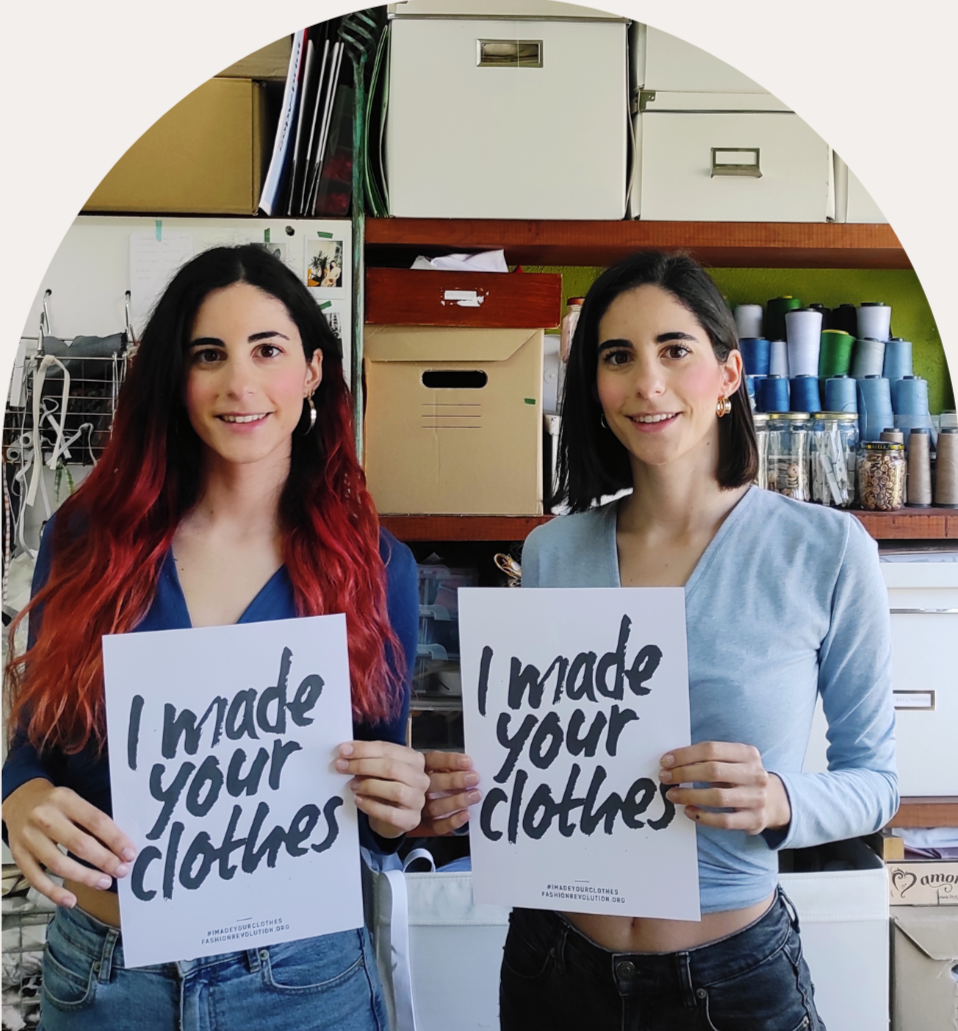
All our garments are made locally in Portugal by people who care and love what they do. We know all our seamstresses (at the moment we are mainly working with Manuela, but when needed we work with other seamstresses) and you can know them too, because in our products we have a card with a photo of who made it and where.
Production is one of many phases of a product from a collection and making it right is one of our passions!
Some pieces are also made in our own studio, by us, Raquel and Sofia. We make the patterns, do the mock-ups and we do the cutting and sewing. On other occasions we only do the cutting of the pieces before handing them over to our seamstress.
Sustainable
packaging
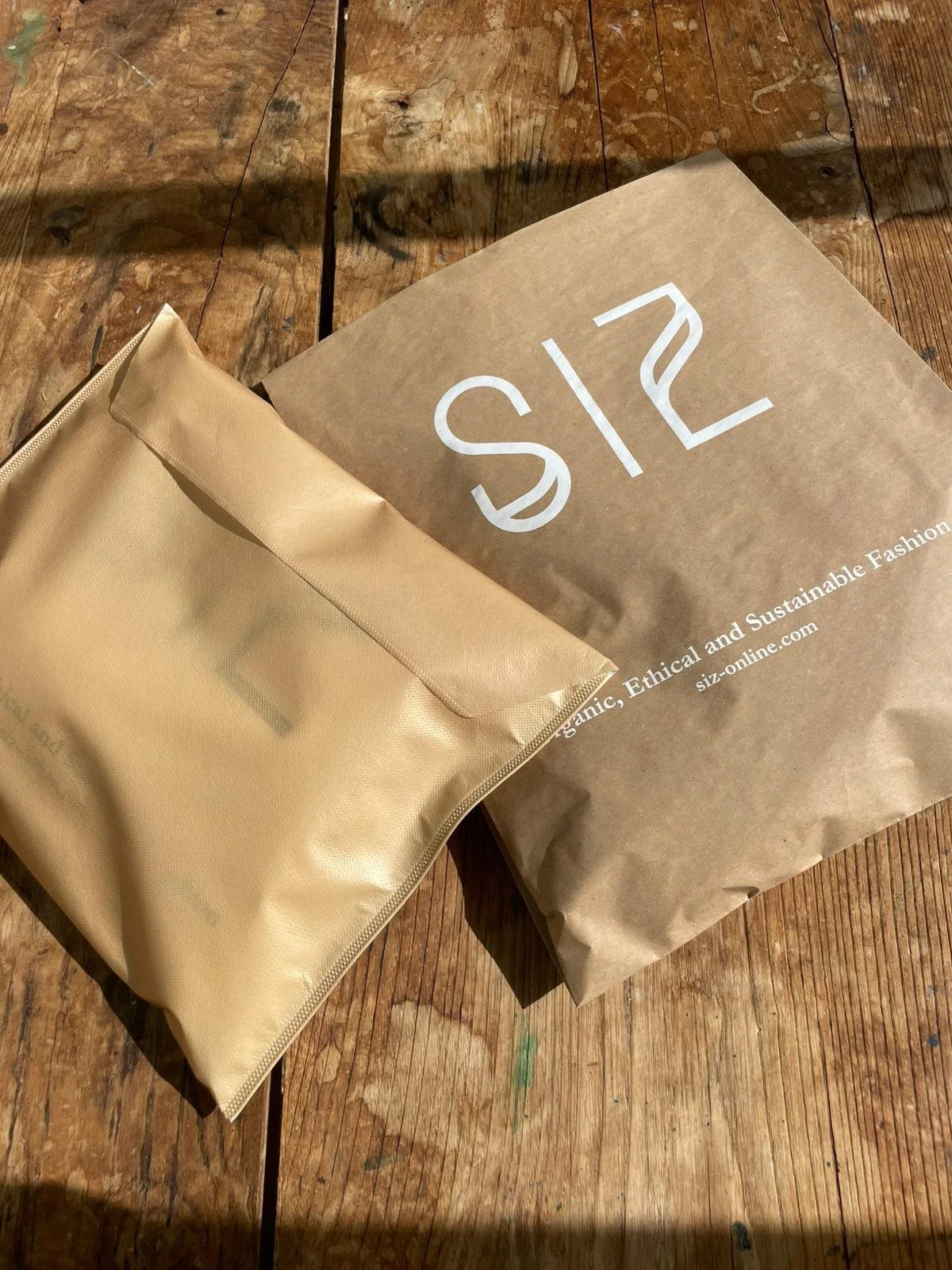
We understand how important packaging is and how important it is for packaging not to harm the planet. We believe in sustainable and ecological alternatives for packing your pieces and we’ve been improving and changing since the beginning. From our organic cotton labels and tags made from recycled paper to our returnable mailers or made of recycled paper, you can find several sustainable items that make part of our packaging.
We also wrap the pieces in organic cotton tote bags (made in our studio and printed with natural ink) or in repurposed paper and we don’t use plastic in any way of the process. When sending pieces to our wholesale partners, we always use repurposed boxes and paper.
We use craft tape when needed and compostable stickers with our logo. Other than that, all our flyers and catalogs are printed in recycled paper and are printed in a conscious amount.
If you have any question about our packaging or material we use at the studio, just let us know by sending an email or a DM at Instagram!
Monitoring and Assurance
We have great and strong relationships with all our suppliers built in mutual trust and respect. We know all of them and visited 90% of their facilities. We ask from them the same commitment with sustainability and labor conditions and to corporate with transparency about products and their origins and details as well as about details of production and the people that work there.
Plus, in the production of our pieces, the ones that are not made by us in our studio, are made either in small ateliers in a 20-35 minutes’ drive distance or 80% of the time at our main seamstress atelier at a 5 minutes’ walk from us. This means we have a total control of the production, and we can visit them any time we want, and we see fit. We strongly trust them but even so, we like to keep visiting, sometimes to test the prototypes or discuss the early steps, other times to check how the production is going.
Climate Change
Climate Change is one of the biggest concerns of SIZ. Our second collection, for example, was all inspired by it, and a scream to raise awareness to this matter.
We know that as a small brand we have to think in the small changes we can do, like changing our light globes, no plastic at all, repurposed everything, working outside to use the natural light.
But we try to make a difference with bigger steps as well: All our packaging is sustainable, from the organic labels and tags made from t-shirts off-cuts to the recycled paper, compostable mailers, and shipping labels. We only use sustainable fabrics, such as organic ones, Tencel, hemp or deadstock linen and cotton or even small denim off-cuts. Other important thing is to keep our chain small and close to us. The Fabrics and accessories all come from Portugal. And the manufacturing is made or in our own studio or at a maximum distance of 20km and 90% in 450m from our studio/showroom – doing so we can walk instead of using our car. Unless we must carry a roll of fabric. If we can, we carry everything in big fabric bags. By manufacturing locally and not using our car in big travels we are reducing our C02 emissions.
Chemicals
By using organic fabrics with GOTS certification, from trusty and certified suppliers like we do, we know that our fabrics are safe from harmful chemicals. And when we use the deadstock or off-cuts from other productions, even when these materials are organic, they are not being produced for us, we are only using them because someone already put them in this world and didn’t want them anymore – this way we are giving them a new purpose – But some may have used chemicals in their production.

Waste
As mentioned before, we care a lot about waste, and this is something that can happen before, during and after the production of a piece. And that’s why we created the Take Back Program, where a customer can turn back its piece, after 5 years - but we hope that it’s only after much more time than that – if they are not using it anymore, either it’s because it’s damaged by some reason or they don’t like it or don’t fit. We will then use this piece to recycle or to reuse. By doing this the customer will receive a discount to use at our store. We hope to bring awareness about the importance of caring about your clothes and not just throwing them away when they don’t interest you anymore.
We also have the Sell 1 buy 1 Program, in partnership with White Stamp. We accept old clothes from other brands, and we will *** them. The customer receives a discount in our store accordingly to the value to their piece.

Water
By using deadstock and off-cuts we are decreasing the amount of water needed produce our fabrics, since we are only using material that already existed and had already required water in its production and was discarded by others.
Also, organic cotton and lyocell use less water in their production and that’s one of the reasons their one of the best materials.
Microplastics
At SIZ we don’t use many fabrics that are not natural, in fact we only have some pieces that are made with up to 5% of elastane (around 10%) and even our elastic band is made of organic cotton and natural rub. Our pieces are made with natural fibers because we know how harmful microplastics are for the planet, animals, and human beings, and we care about all.
Traceability
Suppliers is one of our biggest concerns. We look for quality and trust and we ask to our partners for the same transparency as we practice. We have strong relationships with all of them and if for some reason we can’t connect or feel safe and can’t fully trust a supplier, we don’t go further in that partnership.
Now all or supplier are from Guimarães or Vila Nova de Famalicão and our production is all in Setubal - 80% in Sesimbra.

Transparency
Transparency is one of our values at SIZ. We think that for a brand to be a Sustainable one, should be a Transparent one too. That’s why we are proud to show you all the behind the scenes over Instagram, Newsletters and here at the website.
Other than that, you can check on the products’ pages who made the piece and about the material (so you know more about what you are purchasing and why is it sustainable).
Plus, we show you our price breakdown too.
You can see here the price breakdown
We are always improving, and we are at this moment working with good partners to present you even more details about the pieces, so keep tuned. And if you have any feedback, just hit us with an email.

Other Sustainable Efforts
Climate Change is a serious global issue and we really care about it since day one of SIZ. See below some of our efforts to protect our planet.
Turn your old pieces into new SIZ pieces!
For each piece sold at siz-online.com we plant a tree
We want to repeat this as soon as possible! Want to join us?
Return your old SIZ pieces for recycling and we give you a special discount
No clothing should be left behind. That’s why we selected our samples and archive pieces and offer them with a special discount!
As mentioned above, we take our packaging very seriously, and all details matter.